
Suivels Auto / Symptoms / 03
Brake problems
Brakes give plenty of warning before they become dangerous, but the warnings are easy to normalise. Most of what follows is about telling the routine from the urgent.
What you are hearing or feeling
- High squeal when braking
- Often the wear indicator, a small metal tab designed to make exactly this noise when the pads get low. It is doing its job.
- Grinding, metal on metal
- Usually means the friction material is gone and metal is contacting the rotor. This damages the rotor quickly and should not be driven on.
- Pulsing or vibration through the pedal
- Commonly rotor thickness variation or warping, felt most under steady braking from speed.
- Soft or spongy pedal
- Air in the hydraulic system, a fluid leak, or a failing master cylinder. Treat as serious.
- Pedal slowly sinking to the floor
- Usually a hydraulic fault. Do not drive the vehicle.
- Pulling to one side
- Often a sticking caliper or uneven pad wear, sometimes a suspension or tyre issue rather than brakes.
What usually causes it
Pads
The wearing part. How long they last depends enormously on driving style and traffic. City driving in the DMV is harder on pads than open-road miles.
Rotors
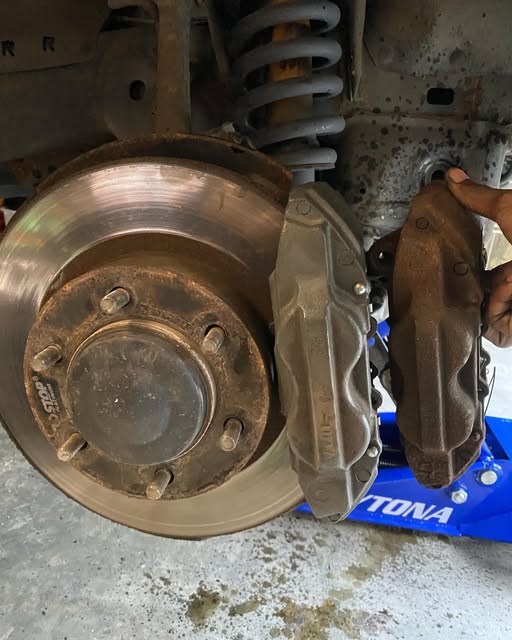
Can wear thin, develop thickness variation, or corrode. Sometimes resurfaced, often replaced with the pads.
Calipers and hardware
Slide pins seize, especially with age and road salt. A sticking caliper causes uneven wear, pulling, and heat.
Brake fluid
Hygroscopic, meaning it absorbs moisture over time, which lowers its boiling point and can make the pedal feel soft under repeated hard use.
Flexible hoses and lines
Perish or corrode. A leak here is a safety fault, not a maintenance item.
Why this still needs a proper look
Brakes are the one system where a guess is not acceptable. The same squeal can be a wear indicator, glazed pads, or trapped debris, and the same soft pedal can be air, moisture or a failing cylinder. It needs the wheels off, the thickness measured, and the hydraulics checked before anyone says what it needs.
Get it checked
We come to the car.
Tell us what it is doing and where it is. We work at your home, your job, or the roadside across DC, Maryland and Northern Virginia.
Other symptoms